Expert insights on wooden pallets, wood types, international standards, and packaging solutions to help you make informed decisions.
Wood Guide
Types of Wood Used for Pallets in Pakistan
Choosing the right wood for pallets is crucial for ensuring product safety during transit, managing costs, and meeting international shipping standards. In Pakistan, several wood species are commonly used for pallet manufacturing, each with unique characteristics.
1. Eucalyptus (Safeda)
Eucalyptus is the most popular choice for commercial pallet manufacturing in Pakistan. It grows abundantly in Punjab and Sindh regions, particularly around Lahore, making it readily available and cost-effective. Eucalyptus offers an excellent balance of strength and weight — it's strong enough to handle heavy loads while remaining relatively lightweight for shipping. The wood has natural resistance to moisture and pests, which extends pallet lifespan significantly. At Woodage, we primarily use Eucalyptus for all our standard pallet production.
2. Kikar (Acacia / Babool)
Kikar wood is known for its exceptional hardness and durability. It's one of the strongest local woods available in Pakistan, making it ideal for heavy-duty pallets that need to carry extremely heavy loads. However, Kikar is heavier than Eucalyptus and more expensive, so it's typically used for specialized applications rather than standard pallets. The wood's dark color and dense grain make it resistant to wear and impact damage.
3. Pine (Chir)
Pine is commonly used in northern Pakistan, sourced primarily from KPK and northern Punjab. It's a softwood that's easy to work with and takes nails well without splitting. Pine pallets are lighter than hardwood alternatives, making them suitable for air freight and export shipments where weight is a factor. However, pine is less durable than Eucalyptus and requires proper treatment to resist moisture.
4. Poplar (Safeda Poplar)
Poplar is a fast-growing softwood that offers the most economical option for one-way or disposable pallets. It's very lightweight and easy to process, but lacks the strength and durability of hardwoods. Poplar pallets are best suited for light-weight goods and single-use export shipments where the pallet won't be returned.
5. Shisham (Rosewood)
Shisham is a premium hardwood that's extremely strong and durable. While it makes excellent pallets, its high cost and limited availability make it impractical for large-scale pallet production. Shisham is occasionally used for specialized heavy-duty pallets where maximum strength is required.
Comparison Table
Wood Type
Strength
Weight
Cost
Durability
Best For
Eucalyptus
High
Medium
Moderate
Excellent
All-purpose, export pallets
Kikar
Very High
Heavy
High
Excellent
Heavy-duty, industrial
Pine
Medium
Light
Moderate
Good
Air freight, export
Poplar
Low-Medium
Very Light
Low
Fair
One-way, disposable
Shisham
Very High
Heavy
Very High
Excellent
Specialized heavy-duty
Our Recommendation
For most businesses in Pakistan, Eucalyptus is the optimal choice for wooden pallets. It provides the best combination of strength, durability, availability, and cost. At Woodage Pvt Limited, our Eucalyptus pallets are ISPM-15 certified and suitable for both domestic use and international export. Contact us to discuss which wood type best suits your specific requirements.
Standards
ISPM-15 Heat Treatment: Complete Guide for Exporters
If you're exporting goods from Pakistan using wooden pallets or crates, understanding ISPM-15 is essential. Non-compliance can result in shipment rejection, quarantine, or costly delays at ports.
What is ISPM-15?
ISPM-15 stands for International Standards for Phytosanitary Measures No. 15. It's a regulation developed by the International Plant Protection Convention (IPPC) under the FAO. The standard requires all wood packaging materials (pallets, crates, dunnage) used in international trade to be treated to kill pests that could damage ecosystems in importing countries.
Why Was ISPM-15 Created?
Raw, untreated wood can harbor insects like the Asian Longhorn Beetle and Pine Wood Nematode, which have caused billions of dollars in damage to forests worldwide. ISPM-15 was introduced in 2002 to prevent the spread of these invasive species through international trade. Nearly every country that participates in global trade requires ISPM-15 compliance.
Heat Treatment (HT) Process
The most common treatment method is Heat Treatment (HT). The wood must reach a core temperature of 56°C (132.8°F) for a minimum of 30 continuous minutes. This effectively kills all known pests and larvae within the wood. At Woodage, we use industrial heat treatment kilns that are regularly calibrated and monitored to ensure consistent compliance.
The ISPM-15 Stamp
After treatment, each pallet is stamped with the official ISPM-15 mark, which includes the IPPC wheat symbol, the country code (PK for Pakistan), the producer number, and the treatment code (HT for heat treatment). This stamp is your proof of compliance and is checked by customs authorities at importing ports worldwide.
Component
Meaning
IPPC Symbol
Wheat ear logo — indicates official IPPC compliance
PK
Country code for Pakistan
Producer Number
Unique number assigned to certified manufacturer
HT
Heat Treatment — method used
Countries Requiring ISPM-15
Almost all major trading nations require ISPM-15 compliance, including the USA, EU countries, China, Japan, Australia, UAE, Saudi Arabia, and virtually all countries where Pakistani exports are shipped. Without the ISPM-15 stamp, your goods may be rejected at the port, fumigated at your expense, or returned entirely.
Woodage ISPM-15 Certified Pallets
All pallets manufactured by Woodage Pvt Limited are ISPM-15 Heat Treated and certified. We maintain strict quality control throughout the treatment process, and every pallet leaves our facility with the proper ISPM-15 stamp. Whether you're shipping to the Middle East, Europe, or Asia, our pallets ensure smooth customs clearance.
Products
Wooden Pallet Types, Sizes & How to Choose
Not all pallets are the same. Understanding the different types and sizes helps you choose the right pallet for your products, storage system, and shipping requirements.
Stringer Pallets
Stringer pallets use two or three long boards (stringers) running lengthwise to support the deck boards. They're the most common and economical pallet type. Stringer pallets provide 2-way forklift entry (from the ends only). They're suitable for most general warehousing and shipping applications. They cost less to manufacture and are easy to repair.
Block Pallets
Block pallets use solid wood blocks between the top and bottom deck boards. They provide 4-way forklift entry (from all four sides), making them more versatile in warehouses and loading docks. Block pallets are stronger and more durable than stringer pallets, making them ideal for heavy loads and automated handling systems.
Standard Pallet Sizes
Size (mm)
Region / Standard
Common Use
1200 x 1000
ISO / Most Popular in Pakistan
Export, general industry, warehousing
1100 x 1100
Asia-Pacific Standard
Trade with China, Japan, Korea, Australia
1200 x 800
EUR / Euro Pallet
European export, retail distribution
1219 x 1016
GMA / North American
US and Canada trade
Custom
As per requirement
Specific machinery, oversized goods
How to Choose the Right Pallet
Consider these factors when selecting a pallet: the weight of your goods determines whether you need a stringer or block pallet. Your destination country may require a specific standard size. Your warehouse setup (racking system, forklift type) affects whether you need 2-way or 4-way entry. For export shipments, always ensure ISPM-15 compliance.
At Woodage, we manufacture both stringer and block pallets in all standard and custom sizes. Our team can advise you on the best pallet type for your specific application. Contact us for custom pallet solutions tailored to your needs.
Packaging
Essential Packing Materials for Safe Shipping
A good pallet is only half the equation — proper packing materials ensure your goods arrive safely. Here's a complete guide to the essential packaging supplies used in industrial shipping and warehousing.
Stretch Wrap Film
Stretch wrap (also called pallet wrap or cling film) is a highly stretchable plastic film used to secure goods on a pallet. It holds items tightly together, prevents shifting during transport, and protects against dust and moisture. Available in hand-roll and machine-roll formats. Machine stretch wrap is more economical for high-volume operations.
Strapping Bands
PET (polyester) strapping and PP (polypropylene) strapping are used to secure heavy loads on pallets. PET strapping is stronger and used for heavy-duty applications, while PP strapping is more economical for lighter loads. Both are used with manual or pneumatic strapping tools and metal or plastic buckles.
Edge Protectors (Corner Guards)
Cardboard edge protectors are L-shaped boards placed on the corners of palletized goods to prevent strap damage and distribute pressure evenly. They protect product edges during stacking and transport, and add structural rigidity to the pallet load.
Tapes
Various industrial tapes serve different packaging functions. These include BOPP packing tape for sealing cartons, cloth tape for heavy-duty sealing and bundling, double-sided tape for mounting and joining, and masking tape for labeling and temporary marking.
Other Packing Supplies
Additional materials include bubble wrap for cushioning fragile items, foam sheets for surface protection, desiccant packets for moisture control, and shrink wrap for tamper-evident packaging. The right combination depends on your product type, transport mode, and destination.
Woodage Pvt Limited supplies all these packing materials. We offer competitive pricing on stretch wraps, strapping bands, edge protectors, tapes, and all packaging consumables. Contact us for bulk orders.
Maintenance
Pallet Repair & Maintenance: Save Costs, Extend Life
Replacing damaged pallets every time isn't always necessary — or economical. A proper repair and maintenance program can save businesses 40-60% compared to buying new pallets.
Common Pallet Damage Types
The most frequent issues include broken deck boards (top boards that crack under load), split stringers (the main structural beams), loose or protruding nails (safety hazard and product damage risk), and moisture damage (warping and rot from improper storage).
When to Repair vs Replace
Repair when only 1-2 deck boards are broken, nails are loose but structure is sound, minor cracks in stringers, or surface wear without structural compromise. Replace when multiple stringers are broken, more than 50% of deck boards are damaged, the pallet is severely warped, or there are signs of rot or insect damage.
Cost Savings from Repair
Option
Approximate Cost
Savings
New Pallet
PKR 1,500 - 3,000
—
Minor Repair
PKR 300 - 600
60-80%
Major Repair
PKR 600 - 1,200
40-60%
Woodage Repair Services
Woodage Pvt Limited offers professional pallet repair and refurbishment services. We inspect each pallet, replace damaged components with matching wood, re-nail and reinforce the structure, and can re-stamp ISPM-15 certification if required. Contact us for a quote on your pallet repair needs.
Material
Why Eucalyptus is the Best Wood for Pallets
At Woodage Pvt Limited, we chose Eucalyptus as our primary wood for a reason — it's simply the best all-around material for pallet manufacturing in Pakistan. Here's why.
Strength & Load Capacity
Eucalyptus is a hardwood with a density of approximately 600-900 kg/m³, giving it excellent load-bearing capability. A standard Eucalyptus pallet can safely carry 1,000-1,500 kg of static load, making it suitable for virtually all industrial applications from textiles and food products to chemicals and machinery parts.
Natural Pest Resistance
Eucalyptus contains natural oils (eucalyptol) that repel many common wood-boring insects. This inherent resistance means Eucalyptus pallets are less susceptible to pest damage even before heat treatment, adding an extra layer of protection for stored and shipped goods.
Sustainability
Eucalyptus is one of the fastest-growing tree species, reaching harvestable maturity in just 5-8 years. This rapid growth rate makes it a highly sustainable resource compared to slower-growing hardwoods. Pakistan has extensive Eucalyptus plantations, particularly in Punjab, ensuring a consistent and renewable supply for pallet manufacturing.
Cost-Effectiveness
Due to its local abundance and fast growth, Eucalyptus is more affordable than alternatives like Kikar or Shisham while offering comparable or superior performance. This cost advantage translates directly to savings for our clients without any compromise on quality.
Workability
Eucalyptus machines well, accepts nails without excessive splitting, and produces smooth, consistent boards. This translates to uniform pallet dimensions, tight construction, and a professional finish — all important for automated warehousing systems and presentation to international clients.
Every pallet from Woodage is crafted from carefully selected Eucalyptus wood, kiln-dried, and heat treated to ISPM-15 standards. Contact us to learn more about our manufacturing process.
Delivery
Wooden Pallet Supplier Across Pakistan: Cities We Serve
Woodage Pvt Limited delivers ISPM-15 certified wooden pallets to businesses across every major industrial and export hub in Pakistan. Whether you ship textiles from Faisalabad, surgical instruments from Sialkot, or seafood from Karachi port, we provide pallets built to international export standards from premium Eucalyptus wood.
Where We Deliver
Based at Sundar Estate in Lahore, Woodage operates a nationwide delivery network. Our manufacturing facility produces premium wooden pallets, packing materials, and industrial supplies that we ship to clients across Pakistan within agreed timelines.
Karachi
Pakistan's largest port city and export gateway. We supply pallets for seafood exporters, textile shippers, FMCG manufacturers, and pharmaceutical companies operating near Port Qasim and Karachi Port. Our ISPM-15 stamped pallets are accepted at all international shipping lines departing from Karachi.
Lahore
Our home base. Same-day and next-day delivery available across Lahore, including Sundar Industrial Estate, Quaid-e-Azam Industrial Estate, Kot Lakhpat, and Raiwind Road industries. Local clients benefit from the shortest lead times and direct factory pickup options.
Faisalabad
The textile capital of Pakistan. We supply ISPM-15 pallets to fabric exporters, garment manufacturers, and home textile producers shipping to Europe, USA, and the Middle East. Our standard EUR pallets (1200x800mm) are particularly popular with Faisalabad's export-oriented businesses.
Sialkot
Hub for surgical instruments, sports goods, and leather products. Our heat-treated pallets meet the strict export requirements of buyers in the EU, UK, and North America. We understand the precision and quality standards Sialkot exporters demand.
Gujranwala
Major industrial center for engineering goods, fans, and ceramics. We deliver standard and custom-sized pallets suited to heavy machinery and bulk consumer goods produced across Gujranwala's manufacturing zones.
Multan
Pakistan's agricultural export hub. We provide pallets for mango exporters, citrus shippers, cotton processors, and food packaging companies serving the Gulf and European markets. Seasonal demand for export pallets during mango and citrus seasons is fully supported.
Islamabad & Rawalpindi
Twin cities serving pharma, FMCG, and electronics distributors. We deliver to industrial zones in I-9, I-10, and Rawat, as well as warehouses across the federal capital region.
Other Cities
We also deliver to Sheikhupura, Kasur, Sahiwal, Gujrat, Wazirabad, Hyderabad, Peshawar, and other industrial locations on request. Contact us with your delivery address for a quote tailored to your location and order size.
Why Businesses Across Pakistan Choose Woodage
ISPM-15 Certified for Global Export: Every pallet we produce is heat-treated and ISPM-15 stamped, meeting international phytosanitary standards required by customs authorities in over 180 countries.
Premium Eucalyptus Wood: We build our pallets from carefully selected Eucalyptus timber, known for strength, durability, and resistance to splitting. Eucalyptus pallets handle heavier loads and last significantly longer than softwood alternatives.
Custom Sizes Available: Beyond standard EUR (1200x800mm) and ISO (1200x1000mm) pallets, we manufacture custom sizes to match your specific cargo, container loading plan, or buyer requirements.
Complete Packing Solutions: Beyond pallets, we supply the full range of packing materials your shipment needs — plastic and steel strapping, packing tapes, stretch films, edge protectors, and corner boards. One supplier, simpler logistics.
Industries We Supply
Our wooden pallets serve a wide cross-section of Pakistan's economy — textile and apparel exporters in Faisalabad, Lahore, and Karachi; surgical and sports goods manufacturers in Sialkot; food and agricultural exporters shipping mangoes, citrus, rice, and seafood; pharmaceutical companies in Karachi, Lahore, and Islamabad; FMCG and consumer goods brands distributing nationally; engineering and auto parts producers in Gujranwala and Lahore; and chemical and industrial manufacturers across Punjab and Sindh.
How Delivery Works
Our process is straightforward and built for businesses that need reliability. Step 1: Contact us via WhatsApp, phone, or our website with your pallet specifications and delivery city. Step 2: We confirm pricing, lead time, and delivery schedule within hours. Step 3: Pallets are manufactured, heat-treated, and ISPM-15 stamped at our Sundar Estate facility. Step 4: We arrange transport directly to your warehouse or factory anywhere in Pakistan.
Need pallets delivered to your city? Contact Woodage today on WhatsApp at +92 337 891 9703 or email Hello@woodage.com.pk for a same-day quote with delivery time and pricing for your location.
Industrial
Wooden Pallets for Concrete Block & Tuff Tile Making Machines
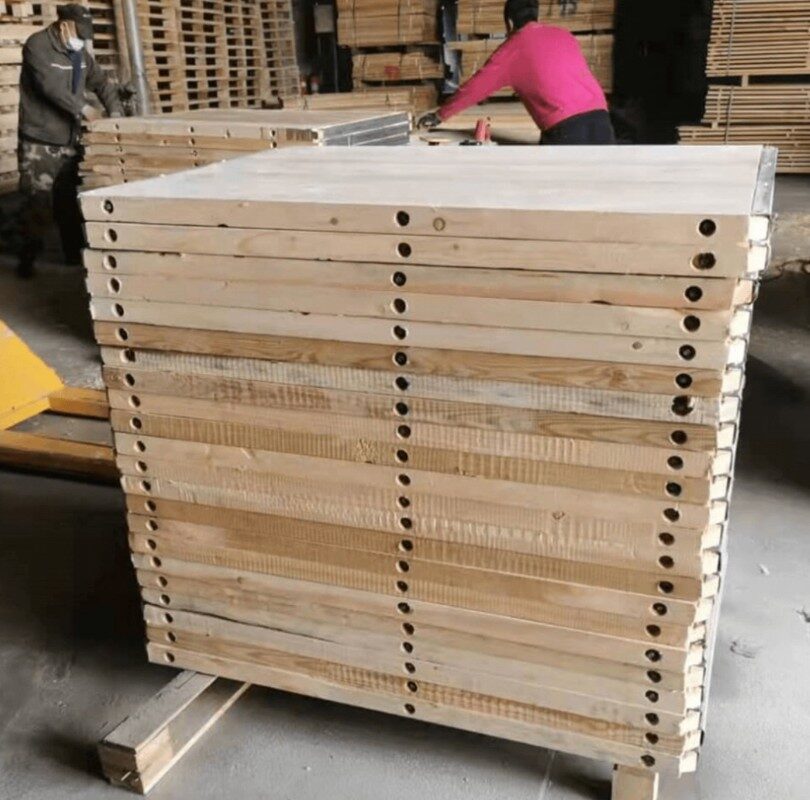
Concrete block making machines and Tuff Tile production lines demand a very different kind of pallet from standard shipping pallets. They face heavy vibration, repeated impact, moisture from wet concrete, and constant load cycles — every single day. At Woodage Pvt Limited, we manufacture purpose-built block machine pallets from premium Kikar (Acacia) wood, engineered to handle the punishing conditions of Pakistan's block and tile production industry.
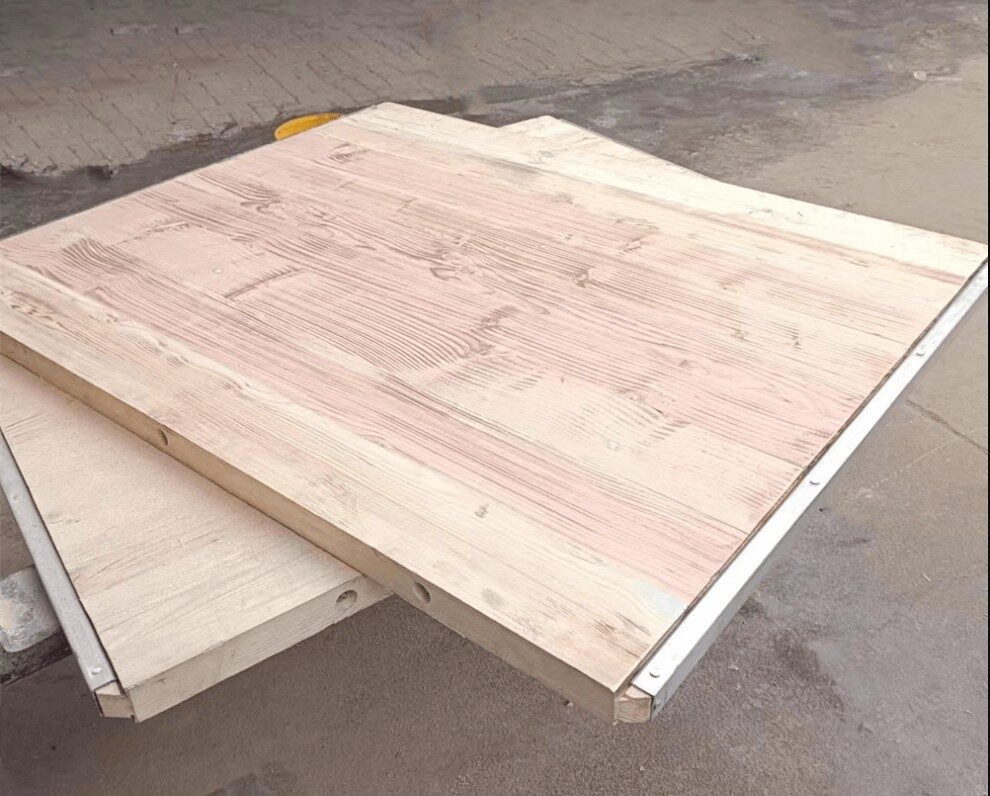
Woodage Kikar wood pallet with galvanized steel reinforced ends — built for block and Tuff Tile machines.
Why Kikar Wood Instead of Pine?
While many international manufacturers use Pine wood for block machine pallets, we deliberately chose Kikar (Acacia) for the Pakistan market. Here's why Kikar is the superior choice for our local conditions:
Higher Density: Kikar has a density of approximately 700-850 kg/m³, significantly heavier and denser than Pine (450-550 kg/m³). This means better vibration absorption and longer service life under heavy concrete loads.
Superior Hardness: Kikar is one of the hardest woods available in Pakistan, with excellent resistance to surface wear from concrete abrasion. Pallets retain their flat surface for many more production cycles.
Natural Moisture Resistance: Kikar contains natural tannins that resist water absorption and fungal growth — critical when pallets are exposed to wet concrete day after day.
Local Availability: Kikar grows abundantly across Punjab and Sindh, making it cost-effective and consistently available for bulk production. No import delays, no foreign exchange issues.
Better for Our Climate: Kikar handles Pakistan's hot, humid summers and dry winters far better than Pine, which can crack or warp under our temperature swings.
Built for Pakistan's Block & Tuff Tile Industry
Across Punjab — Lahore, Gujranwala, Faisalabad, Sialkot, Sahiwal, Multan, and beyond — thousands of concrete block factories and Tuff Tile manufacturers run their machines around the clock. Whether you produce hollow concrete blocks, solid blocks, paver tiles, kerb stones, or interlocking Tuff Tiles, the pallet is the foundation of your production cycle.
We manufacture pallets specifically for:
Concrete block making machines — automatic, semi-automatic, and manual
Tuff Tile production lines — paver and interlocking tile machines
Hollow block machines — 4 inch, 6 inch, 8 inch, and 12 inch blocks
Kerb stone and curbstone production
Solid concrete brick machines
Paver block machines
Technical Specifications
Our Kikar wood block machine pallets are built to demanding technical standards:
Material: Grade A solid Kikar (Acacia) wood boards, hand-selected
Density: 700-850 kg/m³
Moisture content: Below 18% after kiln drying
Drying process: Special kiln drying to prevent warping, swelling, and cracking
Joint construction: Male-female groove joints with locking screws (12mm) for maximum board stability
End reinforcement: Channel steel (1.5mm) fixed at both ends to absorb impact
Corner protection: Steel sheet covers on all four corners to prevent edge damage
Static bending strength: More than 38 MPa (longitudinal)
Temperature resistance: Stable performance up to 80°C
Custom sizes: Manufactured to match your specific block machine model
Construction Features That Extend Pallet Life
Double-Headed Bolt Locking: We use Q235 grade double-headed bolts with locking nuts to fasten the boards. This prevents loosening from continuous machine vibration — the number one cause of pallet failure in block plants.
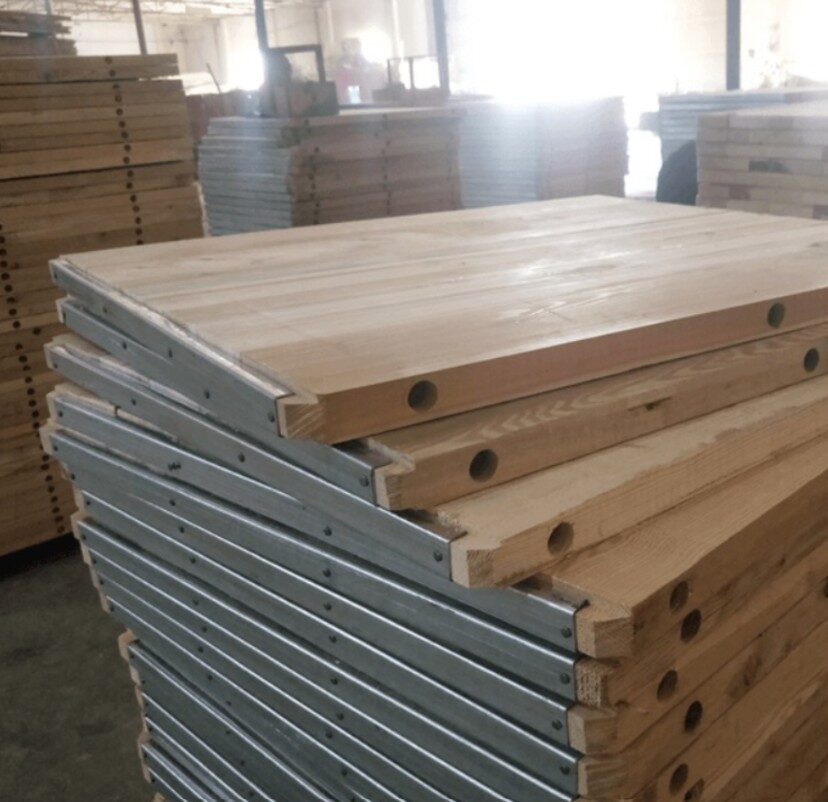
Hot-Dip Galvanized Steel Ends: Both ends of each pallet are reinforced with C-type galvanized steel covers. This anti-oxidation steel protects the most vulnerable part of the pallet from impact damage during machine ejection and stacking.
Male & Female Groove Joints: Instead of butt-joining boards, we use male-female grooves so each board locks into the next. This dramatically reduces gap formation and surface deformation under load.
Galvanized Corner Linings (Optional): For extra-heavy-duty applications, we offer pallets with galvanized steel linings inside all four corners — eliminating corner cracking even in the most aggressive machines.
Close-up view of our pallets showing the galvanized steel end caps and groove-joint construction.
Common Pallet Sizes for Block & Tile Machines
The right pallet size depends on your machine make and model. We commonly produce:
850 x 600 mm
900 x 650 mm
950 x 700 mm
1000 x 700 mm
1100 x 850 mm
1300 x 850 mm
Custom dimensions matched to your machine specification
Bring us your machine details — make, model, or even just the existing pallet dimensions — and we'll manufacture an exact match.
Why Punjab's Block Plants Choose Woodage
Bulk production at our Sundar Estate facility — block and Tuff Tile pallets ready for delivery across Pakistan.
Built for Local Conditions: Our pallets are designed with Pakistan's climate, machinery, and concrete mix in mind — not adapted from imports.
Bulk Order Capacity: Whether you need 50 pallets or 5,000, our Sundar Estate facility can deliver on schedule.
Direct Manufacturer Pricing: No middleman, no import duties, no foreign exchange markup. You buy direct from the factory.
Replacement & Repair: When pallets eventually wear out, we offer repair services and discounted replacement programs for repeat customers.
Fast Delivery Across Pakistan: We deliver to block plants throughout Punjab and beyond — Lahore, Gujranwala, Sialkot, Sahiwal, Faisalabad, Multan, Bahawalpur, Karachi, Hyderabad, and other industrial cities.
How to Order Block Machine Pallets
Getting the right pallets for your block or Tuff Tile machine is simple:
Step 1: Contact us with your machine make/model and required pallet dimensions
Step 2: We confirm specifications, quantity, and quote within hours
Step 3: Pallets are manufactured from kiln-dried Kikar wood with full reinforcement
Step 4: Quality-checked and delivered to your factory site
Need block or Tuff Tile machine pallets? Contact Woodage today on WhatsApp at +92 337 891 9703 or email Hello@woodage.com.pk. Send us your machine details and we'll provide a same-day quote with bulk pricing.
Agriculture
Wooden Pallets for Corn Storage & Ganji Pyramid Stacking
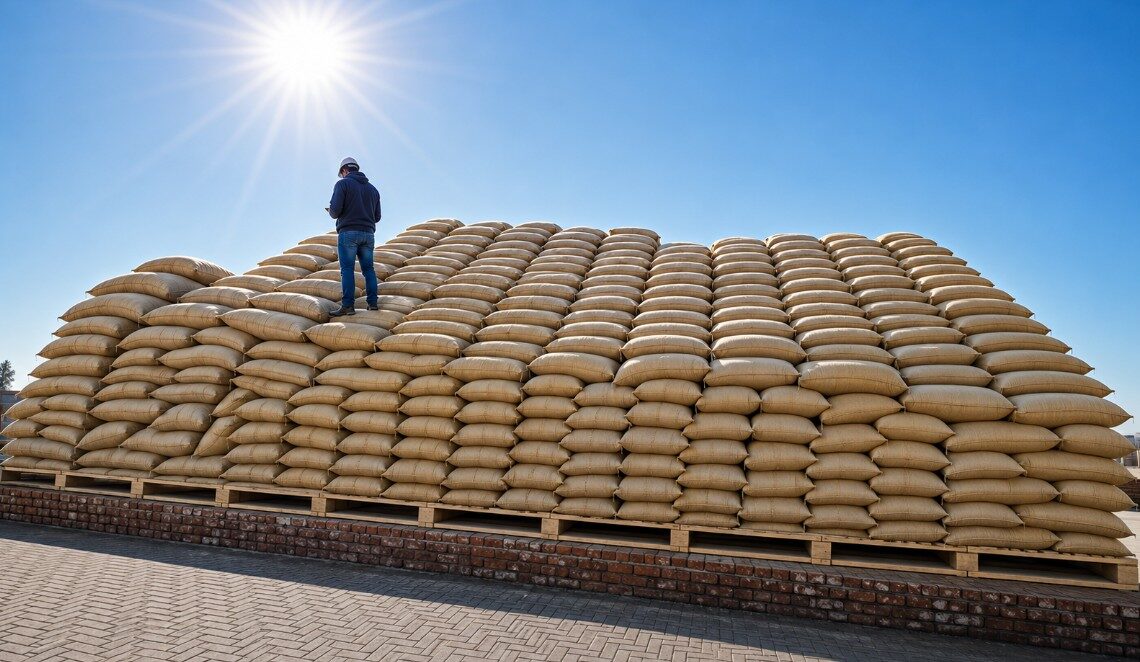
Across Pakistan's grain belt, mountains of corn, wheat, and rice are stored in massive open-air pyramid stacks — locally known as ganji storage. Whether you're a corn trader in Okara, a wheat stockist in Sahiwal, a rice exporter in Sheikhupura, or a feed mill operator in Punjab, the foundation under your stack matters as much as the bags themselves. At Woodage Pvt Limited, we manufacture purpose-built Sofeda wood pallets designed specifically for ganji-style pyramid stacking of grain bags — built to last 5 years or more in tough open storage conditions.
Pyramid (ganji) stacking of corn bags on wooden pallets — the foundation that protects grain from ground moisture and ensures proper air circulation.
Why Wooden Pallets are Essential for Grain Storage
Storing grain bags directly on the ground — whether concrete, brick, or earth — is a costly mistake. Without a proper wooden pallet base underneath, you face serious losses every season:
Ground moisture seeps upward into the bottom layers of bags, causing fungal growth, aflatoxin contamination, and grain spoilage
No air circulation means trapped heat and humidity build up inside the stack, accelerating spoilage
Pest and rodent access from the ground level damages bags and contaminates stored grain
Bottom bags get crushed against rough surfaces, tearing fabric and spilling product
Forklift handling becomes difficult or impossible without a pallet base to lift from
A proper wooden pallet underneath your ganji stack solves every one of these problems at once.
How Wooden Pallets Reduce Storage Losses
Breathing Space & Air Circulation: The most important benefit. Our pallets lift the bottom layer of bags 3-4 inches off the ground, creating an open air channel underneath the entire stack. This air movement carries away moisture and heat that would otherwise be trapped — keeping the entire pyramid dry from the bottom up. Without this circulation, the bottom 2-3 layers of any large stack will begin to spoil within weeks during humid weather.
Moisture Barrier: Concrete and brick floors absorb and release moisture constantly, especially during monsoon season. Wooden pallets create a physical gap between the wet ground and your stored grain. This single feature alone can prevent 5-10% of the bottom-layer spoilage that ganji storage typically suffers.
Loss Reduction: Storage losses in Pakistan's traditional grain storage average 8-12% per season. Pallet-based storage typically cuts these losses to under 2%. For a 1,000-ton stack, that's the difference between losing 100 tons or losing just 20 — a massive financial impact.
Easier Handling: Forklifts and pallet jacks can lift, move, and re-stack pallet-based ganjis far more efficiently than ground-stacked ones. This saves labor cost and reduces bag damage during loading and unloading for transport.
Pest Protection: Lifted storage discourages rats, mice, and crawling insects that would otherwise burrow directly into ground-level bags. Combined with proper warehouse hygiene, pallets significantly reduce pest-related losses.
Why Sofeda (Eucalyptus) Wood is Best for Ganji Storage
At Woodage, we manufacture our grain storage pallets from Sofeda wood (Eucalyptus) — and the choice matters more than most farmers realize. Here's why Sofeda outperforms other woods for this specific application:
Naturally Termite Resistant: Sofeda contains natural oils (eucalyptol) that repel termites, wood borers, and ants — the most common pests that destroy wooden pallets in long-term grain storage. This natural pest resistance means our pallets don't need chemical treatment to last in field conditions.
Strong Load-Bearing Capacity: Sofeda has a density of 600-900 kg/m³, easily supporting the massive weight of a fully-loaded ganji stack. A standard Woodage Sofeda pallet supports 1,000+ kg static load comfortably.
Moisture-Resistant Hardwood: Sofeda doesn't swell, warp, or split when exposed to ground moisture and seasonal humidity changes the way softer woods do.
Long Lifespan in Open Storage: A properly built Sofeda pallet retains structural strength for 5 years or more even in harsh open-air ganji conditions — far longer than Pine or other softwoods that crack and rot within 1-2 seasons.
Locally Grown & Sustainable: Pakistan has extensive Sofeda plantations across Punjab, ensuring consistent supply and competitive pricing. No imports, no foreign exchange concerns.
Why Wooden Pallets are Better Than Bamboo Pallets
Some farmers and stockists in Pakistan still use bamboo mats or bamboo pallets under their ganji stacks. While bamboo seems cheaper upfront, wooden pallets are the smarter long-term choice:
Load capacity: Bamboo flexes and crushes under heavy stack weight. Sofeda wood pallets stay rigid and flat, evenly distributing the load across the bottom layer of bags.
Lifespan: Bamboo typically lasts 1 season — maybe 2 if you're lucky. Sofeda wood pallets last 5+ years, making them dramatically cheaper per season of use.
Pest resistance: Bamboo is highly susceptible to termites and weevils, which then spread into your stored grain. Sofeda's natural oils repel pests instead of attracting them.
Forklift compatibility: Bamboo mats can't be lifted by forklifts. Wooden pallets allow mechanized handling — saving labor and time.
Stability: Bamboo pallets shift, bend, and collapse under uneven loading. Wooden pallets stay in place even under uneven pyramid loading.
Cost per use: A bamboo pallet might cost half as much, but if it lasts 1 season versus 5+ for Sofeda wood, the total cost of bamboo over 5 years is 2-3x higher.
For commercial grain storage where you're protecting tons of valuable product, wooden pallets are not an expense — they're an investment that pays back many times over.
Woodage Construction Specifications
Our corn and grain storage pallets are built to demanding specifications for long open-air storage life:
Stringer thickness: 2 inch (50mm) — heavy-duty bottom rails for maximum load support
Plank thickness: 1 inch (25mm) — thick top boards that resist crushing and splintering
Useful life: Minimum 5 years under typical ganji storage conditions
Load capacity: 1,000+ kg per pallet (static load)
Ground clearance: 3-4 inches for full air circulation underneath stack
Custom sizes: Available — match your warehouse layout or stack dimensions
Common Applications in Pakistan
Our Sofeda wood storage pallets are used across the country for:
Corn (makka) storage — feed mills, traders, and exporters
Wheat (gandum) ganji stacking — flour mills and government procurement centers
Rice (chawal) storage — paddy stockists and rice exporters
Animal feed storage — poultry feed mills and dairy farms
Cotton seed and oil cake storage
Fertilizer bag storage at distribution warehouses
Sugar and pulse stacking at wholesale godowns
Sizes Commonly Used for Ganji Stacking
The right pallet size depends on your bag dimensions and stack layout. Common sizes our customers order:
1200 x 1000 mm (48 x 40 inch) — the most popular for corn and wheat
1200 x 1200 mm — square format for flexible stacking
1100 x 1100 mm — Asian standard, ideal for rice bags
Custom dimensions matched to your warehouse or godown layout
Why Punjab's Grain Traders Choose Woodage
Built for Open-Air Storage: Most pallets are designed for indoor warehouse use. Ours are built specifically to withstand sun, rain, and humidity — the realities of Pakistani ganji storage.
Bulk Order Capacity: Whether you need 100 pallets for a small godown or 5,000 for a large procurement center, our Sundar Estate facility delivers on schedule.
Direct Manufacturer Pricing: No middlemen, no trader markups. Buy direct from the factory at the best price.
Fast Delivery Across Punjab: We deliver to grain belts across Punjab — Okara, Sahiwal, Pakpattan, Vehari, Bahawalnagar, Sheikhupura, Hafizabad, Gujranwala, Faisalabad, and beyond.
Reusable for Multiple Seasons: Our 5-year minimum lifespan means you amortize the cost across many crop cycles, making the per-season cost lower than disposable alternatives.
Order Sofeda Wood Storage Pallets
Getting the right pallets for your grain storage is straightforward:
Step 1: Contact us with your storage application (corn, wheat, rice, etc.), pallet quantity, and preferred size
Step 2: We confirm specifications, lead time, and quote within hours
Step 3: Pallets are manufactured from kiln-dried Sofeda wood with 2-inch stringers and 1-inch planks
Step 4: Quality-checked and delivered to your warehouse, godown, or procurement site
Need wooden pallets for corn, wheat, or rice ganji storage? Contact Woodage today on WhatsApp at +92 337 891 9703 or email Hello@woodage.com.pk. Tell us your storage requirements and we'll provide a same-day quote with bulk pricing for your operation.
New Product
Nailless Plywood Boxes: The Fumigation-Free Export Packaging Guide
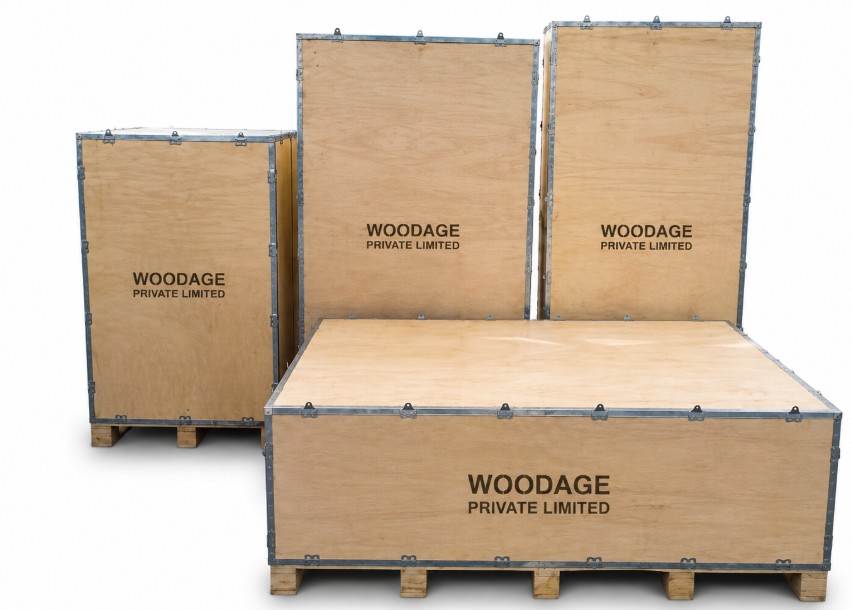
For decades, Pakistani exporters have shipped their goods in traditional nailed wooden crates — heavy, single-use boxes that need ISPM-15 heat treatment stamps, take up warehouse space, and slow down customs clearance. There is now a smarter alternative. Woodage Pvt Limited is proud to introduce the nailless plywood box — manufactured for the first time in Pakistan at our Sundar Estate facility in Lahore. Foldable, reusable, fumigation-free, and custom-built to your cargo dimensions.
Woodage nailless plywood boxes — custom-built in any size, from small parts boxes to large machinery crates on forklift pallet bases.
What is a Nailless Plywood Box?
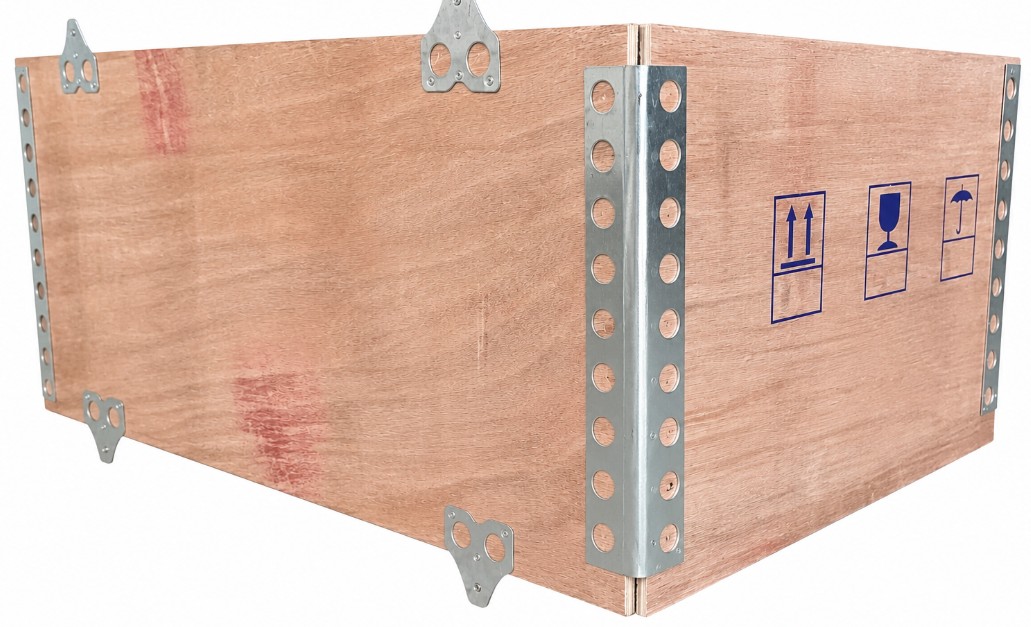
A nailless plywood box is an export packing box made from precision-cut plywood panels joined with galvanized steel buckles and edge strips — no nails, no screws, no glue. The steel edges act as hinges and locks: the panels simply fold together and click into place. Assembly takes minutes and needs no tools, no carpenter, and no hammer. To open the box at destination, the buckles unclip and every panel comes away clean — ready to be folded flat and used again.
The locking system: galvanized steel buckles and perforated corner strips replace every nail in the box.
No Fumigation Needed — The ISPM-15 Advantage
This is the single biggest reason exporters worldwide are switching to plywood boxes. ISPM-15 is the international regulation that requires solid wood packaging (pallets, crates, boxes) to be heat treated or fumigated and stamped before crossing borders — to stop the spread of timber pests.
Plywood is exempt. Because plywood is a processed wood product (thin veneers bonded under heat and pressure), international phytosanitary rules classify it as pest-free by manufacture. That means a Woodage nailless plywood box ships to any country with:
No heat-treatment stamp required
No fumigation certificate to arrange or pay for
No risk of port rejection over missing or unreadable ISPM marks
Faster customs clearance at both ends of the shipment
For exporters of textiles, machinery, surgical instruments, and auto parts, this removes an entire compliance step from every single shipment.
Nailless Plywood Box vs Traditional Nailed Crate
Factor
Nailless Plywood Box
Traditional Nailed Crate
Export compliance
ISPM-15 exempt — no fumigation, no stamp
Heat treatment + ISPM-15 stamp required
Assembly
Minutes, tool-free, no skilled labor
Carpenter with hammer, nails, saw
Storage & transport
Folds flat — saves up to 70% space
Rigid — occupies full volume when empty
Reusability
Opens and re-closes without damage — multi-trip
Usually destroyed on opening (pry bar)
Weight
Lighter — lower air & sea freight cost
Heavier solid timber construction
Safety
No protruding nails — safe for goods & workers
Nail injuries and cargo scratches common
Appearance
Clean, smooth panels — printable with your logo
Rough boards with gaps
Ideal for Lithium Battery Packing Boxes & Covers
Lithium batteries — for solar energy storage, UPS systems, EVs, and telecom — are among the most demanding cargo types to pack. Nailless plywood boxes are exceptionally well suited as lithium battery packing boxes and protective covers:
No nails means no puncture risk — a stray nail inside a battery box is a short-circuit and fire hazard; nailless construction removes it completely
Snug custom fit — each box is built to the battery's exact dimensions, so cells and packs cannot shift in transit
Rigid impact protection — plywood panels with steel edges shield terminals and casings from drops and knocks
Ventilation on request — breather openings can be built in where transport rules require them
Reusable covers — for battery racks and cabinets moved between sites, the box works as a re-closable protective cover, not just one-way packaging
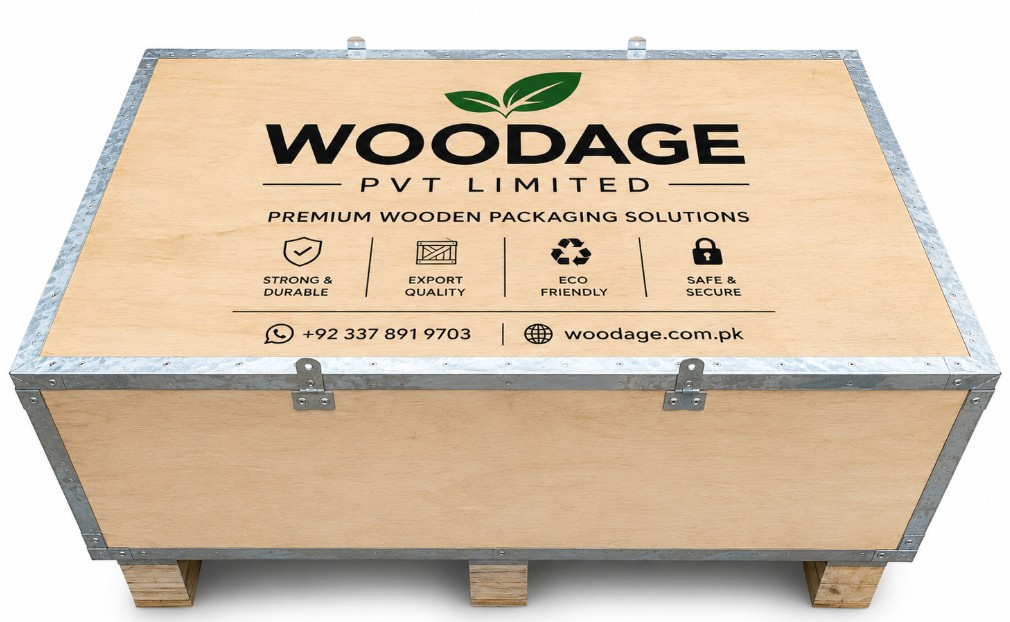
A Woodage nailless plywood box on a 4-way forklift pallet base — custom logo printing included on request.
Foldable, Flat-Pack, and Reusable
Every Woodage nailless box ships to you folded flat. A stack of 100 flat-packed boxes occupies roughly the space that 30 assembled crates would — cutting your inbound freight and warehouse cost by up to 70%. When an order is ready, your team clicks the panels together in minutes. After delivery, the box folds flat again for the return trip or the next shipment. Over multiple trips, the cost per shipment drops far below a new nailed crate every time.
Custom Sizes — Built Around Your Cargo
We do not force your cargo into standard boxes. Every nailless plywood box is manufactured to your exact cargo dimensions — length × width × height — with plywood thickness (6–18 mm) and steel reinforcement engineered for your cargo weight, from 25 kg parts boxes up to 5,500 kg machinery crates. Options include:
2-way or 4-way forklift pallet base — or base-free for lighter boxes
Load capacity engineered per cargo — 25 to 5,500 kg
Custom logo and shipping-mark printing — your brand on every box
Handling symbols — fragile, this-way-up, keep-dry markings printed as needed
Machinery and spare parts export — the classic machine packing box
Electronics and appliances — impact-safe, nail-free interiors
Auto parts — engines, transmissions, body panels
Pharmaceutical and surgical instrument export — clean, compliant packaging
Textile and garment export — fumigation-free container loading
Defense and precision equipment — secure, re-closable inspection access
E-commerce and courier shipments — lightweight protection for valuable goods
How to Order Your Nailless Plywood Boxes
Step 1: Send us your cargo dimensions (L × W × H), cargo weight, and quantity
Step 2: We engineer the box — plywood thickness, steel reinforcement, base type — and quote within hours
Step 3: Boxes are manufactured on Pakistan's first nailless plywood box production line at Sundar Estate, Lahore
Step 4: Delivered flat-packed to your facility, ready for tool-free assembly
Ready to switch to fumigation-free export packaging? Contact Woodage today on WhatsApp at +92 337 891 9703 or email Hello@woodage.com.pk. Send your cargo dimensions and we'll provide a same-day quote. View full technical specifications →
Frequently Asked Questions
The most common wood types for pallets in Pakistan are Eucalyptus (Safeda), Kikar (Acacia), Pine (Chir), and Poplar. Eucalyptus is the preferred choice due to its high strength-to-weight ratio, natural pest resistance, and availability in Punjab region. At Woodage, we primarily use Eucalyptus for its optimal balance of quality and cost.
ISPM-15 (International Standards for Phytosanitary Measures No. 15) is a regulation that requires all wooden packaging materials used in international trade to be heat treated or fumigated to prevent the spread of pests and diseases. Pallets must be heated to a core temperature of 56°C for 30 minutes. Without the ISPM-15 stamp, your exports may be rejected at the destination port.
Common pallet sizes in Pakistan include 1200x1000mm (most popular for export), 1100x1100mm (Asia-Pacific standard), 1200x800mm (Euro pallet), and 1219x1016mm (North American). Woodage also manufactures custom sizes based on your specific requirements.
A well-manufactured wooden pallet typically lasts 3-5 years with regular use. With proper maintenance and repairs, the lifespan can extend to 7-10 years. Eucalyptus pallets tend to last longer due to the wood's natural durability and pest resistance. Woodage also offers repair services to extend your pallets' life.
Yes, Woodage Pvt Limited manufactures custom pallets in any size you need. Whether you require oversized pallets for machinery, smaller pallets for display, or non-standard dimensions for specific racking systems, we can build to your exact specifications. Contact us with your dimensions and quantity for a quote.
Pallet repair is typically 40-80% cheaper than buying new pallets. A minor repair (replacing 1-2 boards) costs PKR 300-600, while a new pallet costs PKR 1,500-3,000. Woodage provides professional repair services that restore pallets to full functional condition, including ISPM-15 re-certification if needed.
Our heavy-duty Kikar wood block pallets are compatible with Chinese QT series automatic block machines (QT4, QT6, QT8, QT10, QT12 series), European-manufactured automatic and semi-automatic block plants, and locally manufactured hydraulic presses. They work with all major Tuff Tile, hollow block, paver, and kerb stone production lines. View full specs →
Yes. Woodage delivers ISPM-15 certified wooden pallets to Karachi, Faisalabad, Sialkot, Gujranwala, Multan, Islamabad, Rawalpindi, and other industrial hubs across Pakistan. Grain storage pallets are delivered across the Punjab grain belt including Okara, Sahiwal, Pakpattan, and Vehari.
There is no strict minimum order for standard pallet sizes. For custom sizes or block machine pallets, we typically recommend a minimum of 50 units to optimize production efficiency. Contact us for specific requirements.
Yes. Our grain storage pallets are made from Sofeda (Eucalyptus) wood, which is naturally low in extractives and safe for food contact. They are termite-treated and designed for warehouse environments where wheat, corn, rice, and other grains are stored in ganji (pyramid) stacking. View grain storage pallets →
A nailless plywood box is a modern export packing box made from plywood panels joined with galvanized steel buckles and edge strips instead of nails or screws. It assembles in minutes without tools, folds flat for storage, and is reusable trip after trip. Woodage Pvt Limited is the first manufacturer of nailless plywood boxes in Pakistan. View full specs →
No. Plywood is a processed wood product and is exempt from ISPM-15 regulations, so nailless plywood boxes need no heat treatment, no fumigation, and no phytosanitary certificate for international shipping. That means faster customs clearance and lower export cost compared to solid wood crates.
Yes. Nailless plywood boxes are an excellent choice for lithium battery packing boxes and covers. The nail-free construction removes puncture and spark risk, each box is built snug to the battery's exact dimensions, and the rigid plywood panels with steel edges protect terminals and casings during transport.
Need Pallets or Packaging Supplies?
Get a free quote from Woodage Pvt Limited. Premium quality, competitive prices, fast delivery across Pakistan.